How well run are America’s 50 states? The answer depends a lot on where you live. For the second year, 24/7 Wall St. has reviewed data on financial health, standard of living and government services by state to determine how well each state is managed. Based on this data, 24/7 Wall St. ranked the 50 states from the best to worst run.
Showing posts with label US debt. Show all posts
Showing posts with label US debt. Show all posts
Monday, November 28, 2011

Thursday, November 17, 2011
Never Say Never
| Never Say Never | ||||
| A Look at the Troubling Trend in French Bond Yields | ||||
French bond yields are soaring. That’s what the French might call “mauvaises nouvelles.” In fact, that’s what we might all call “bad news.” It’s one thing when chronic deadbeats like Greece and Portugal struggle to make ends meet. But it is something completely different when the economic pillars of the European economy start showing some cracks. In European trading today, the 10-year French government bond yield hit 3.71%, compared to 2.44% about two months ago. The rapid rise in rates is not that alarming...until you examine it in the context of German bond yields. Take a look at the chart below, which shows the difference (or spread) between French and German bond yields since the launch of the euro.
For most of this 12-year period, 10-year French government bonds offered yields that were roughly identical to German bond yields. In other words, bond investors considered French government bonds about as safe as German government bonds. After the credit crisis of 2008, French bond yields moved slightly higher than German yields, but not dramatically so. More recently, as investors have been dumping the bonds issued by Greece, Portugal, Italy and other “questionable” sovereign issuers, they have been flocking into both French and German bonds as a “flight-to-safety” trade. But look what has happened during the last few weeks. French bond spreads have “blown out,” as the traders would say. Apparently, bond investors are beginning to distrust French debt as a “slight-to-safety” asset, at least relative to German debt. So investors have been selling French government bonds very aggressively for the last several weeks, while continuing to buy German government bonds. As a result, French yields are soaring while German yields are falling, causing the spread between the two to skyrocket to a euro-era record high. The chart below shows the spread between 10-year French bonds and 10-year government bonds to be 1.50%. But that number is already out of date. Today the spread is 1.90%...and widening. So why should we care about all this? Because France is not Greece. Greece has the dubious distinction of spending more of its modern history in default or debt-restructuring than any other euro zone nation, according to the fascinating research of Reinhart & Rogoff. Since gaining its independence 182 years ago, Greece has spent 94 of those years in default or restructuring. Spain is a distant second on the list, having spent only 24% of the last two centuries in default. Then comes Austria at 17% and Germany at 13%. France has never defaulted during the last 200 years...at least not entirely. It did default on its WWI debts to the US. (So let’s put an asterisk next to that one). But in terms of across-the-board sovereign defaults, France has one of the cleanest 200-year records on the European continent. But that was then and this is now. In this present moment in history, the French governments lightly blemished credit history matters little. What matters a lot is that French banks are holding hundreds of billions of euros worth of Greek, Portuguese, Spanish and Italian sovereign debt — the very stuff that is plummeting in value. If the big French banks are in trouble, the French government’s finances will also be in trouble. At least that’s what the math suggests. And it is this frightening math that is causing bond investors to load up on insurance against a default by the French government...as remote a possibility as that may seem.
Thus, the chart above is somewhat shocking. It presents the price of insuring various government bonds against default. (This insurance is called a credit default swap, or CDS). The higher the bar on the chart, the more expensive the insurance. And there’s only one reason why the price of any kind of insurance rises: The underwriter believes the likelihood of a claim has increased. Thus, the price of insuring a 5-year French government bond is now higher than the price of insuring various “junk” and “near-junk” sovereign borrowers! France still carries a AAA rating. Despite that attribute, insuring its debt is more expensive than insuring the “junk” debts of Indonesia and the Philippines. The owners of French government debt can still take some comfort from the fact that French CDS prices are not as high as Kazakhstan CDS prices. But the gap is narrowing. The steep upward trajectory of French bond prices is signaling a new phase of the euro crisis — a phase that may drive multiple sovereign borrowers into default and may claim the life of at least one major Western currency. Therefore, to repeat the quote from James Grant we published in yesterday’s edition: “There are better ports in a monetary storm than government securities denominated in paper money.” | ||||


Sunday, July 31, 2011
Triple A: Global Debt Mania


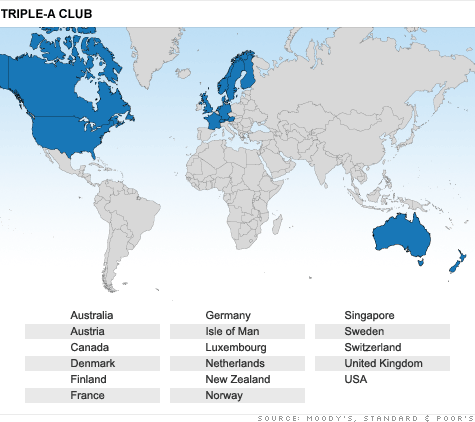
Now, S&P and Moody's are questioning the United States' membership in this exclusive club.
The triple-A rating enables nations to borrow funds at a low cost, because their governments are considered stable and their bonds safe.
The U.S. for example, has seen its dollar become the world's No. 1 reserve currency because its bonds are held in such high regard by investors. They're backed by the "full faith and credit of the U.S. government" -- which until now, has never seriously been called into question.
Prior to November 2007, the United States boasted some of the safest bonds in the world. That started to gradually change with the recession, and now the country's creditworthiness continues to be questioned amid the debt ceiling debates.
Debt ceiling fight: What a downgrade would mean
Investors can discern the "risk" associated with a country's debt, by looking at the cost to insure against a possible default -- through a financial instrument called a credit default swap. In the case of the U.S., that cost surged on Thursday to its highest level since 2009.
By that measure, U.S. bonds are no longer in the clear lead as a safe bet, compared to other triple-A rated countries.
By looking at the prices of 5-year credit default swaps, Norway's debt ranks the safest, followed by Sweden, Switzerland, Finland, the Netherlands and Australia.
Canada, Singapore and Germany also have safer bonds than the United States.
If lawmakers don't come through with a deal to raise the debt ceiling and lower the long term deficit, the U.S. could soon join the ranks of the lower-level, double-A rated countries like China, Spain, Japan, Saudi Arabia and even Kuwait.
3:41PM: Framework between the White House and Congress would raise debt ceiling for two years and reduce spending by $3 trillion. More
Friday, July 29, 2011
Debt fraud bankrupting America & Americans
Debt ceiling impasse: How we got into this mess
July 29, 2011 10:35 p.m. EDT
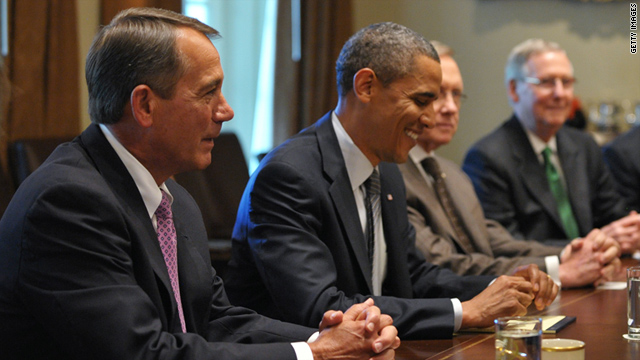
President Obama and congressional leaders have held several debt negotiation meetings at the White House.
STORY HIGHLIGHTS
- The U.S. will default on its loans if the debt ceiling isn't raised by August 2
- Lawmakers have faced months of contentious negotiations on how to deal with debt crisis
- Obama pressed for "grand bargain," while many in GOP favored short-term debt deal
RELATED TOPICS
After several rounds of negotiations, talks are once again at a standstill as the August 2 date nears at which the U.S. will bump up against its borrowing limit.
Here are some key dates on how President Barack Obama and the Congress got into this position:
January
Treasury Secretary Timothy Geithner sends a letter to Congress on January urging lawmakers to act soon to increase the debt ceiling, warning that failure to do so would be disastrous for the economy. The Treasury estimates that U.S. borrowing needs could push the amount of debt past the legal borrowing limit of $14.294 trillion sometime between March 31 and May 16.
Also in early January, the Senate's "Gang of Six," a bipartisan group of three Republicans and three Democrats, begins discussions on a long-term deficit deal
February
17: House Speaker John Boehner says the House of Representatives won't pass a budget for the remainder of the year that doesn't cut spending and that he wouldn't support a series of short-term measures that keep funding at 2010 levels until a deal is reached.
March
Debt-ceiling talks continue privately as Congress and the White House focus their attention on domestic issues such as the economy and immigration -- and global issues involving the uprisings in North Africa and the Middle East.
Congressional Republicans continue to say -- both publicly and in private meetings with Obama -- they will not vote to raise the debt ceiling without conditions controlling federal spending. However, Republicans have not yet come to agreement among themselves about what those conditions should be. Some say there should be spending cuts, while others call for spending caps. Many say there must be a balanced-budget amendment to go along with any vote to raise the debt limit.
Passing a budget to fund the government through September becomes the hot-button issue. An impasse in the talks leads many to speculate that the government could shut down.
April
3: Republican Sen. John Cornyn says he will not vote to raise the debt ceiling unless it's accompanied by systematic reforms to address long-term spending and the national debt. The senator from Texas and member of the Senate Budget Committee also voices support for a balanced-budget amendment to the Constitution as a way to ensure the federal government lives within its means "instead of spending money we don't have."
4: Geithner once again sends a letter to Congress urging lawmakers to pass a plan to avoid defaulting on the country's loans. He says if the debt limit is not increased by May 16, the Treasury has authority to take certain extraordinary measures to postpone the date temporarily that the U.S. would otherwise default on its obligations.
8: Democrats and Republicans narrowly avert a partial shutdown of the federal government, agreeing on a budget deal and a short-term funding extension a little more than an hour before the clock strikes midnight and time runs out. The new funding extension, which cuts spending by $2 billion, will last through the next week.
13: Obama unveils his long-awaited deficit reduction plan, calling for a mix of spending reductions and tax hikes that the White House asserts would cut federal deficits by $4 trillion over the next 12 years without gutting popular programs such as Medicare and Medicaid. Obama's plan includes a repeal of the Bush-era tax cuts on families making more than $250,000 annually -- something sought by Democrats but strongly opposed by Republicans.
15: The budget deal reached to avert a government shutdown wins approval from both the House and Senate, sending it to Obama for his signature. The measure cuts $38.5 billion in spending while funding the government for the rest of the current fiscal year, which ends September 30. With its passage, the White House and Congress will now focus on what are expected to be more rancorous battles over a budget for fiscal year 2012 and the upcoming need to raise the federal debt limit.
The House passes the Republican leadership's 2012 budget proposal, approving a blueprint for cutting federal deficits by roughly $4.4 trillion over the next decade while radically overhauling Medicare and Medicaid -- two popular entitlement programs long considered politically untouchable. Every Democrat opposes the measure. The measure, which Obama opposes, has virtually no chance of clearing the Democratic-controlled Senate.
26: With a showdown over raising the debt limit looming, House Republican leaders say they will hold a series of "listening sessions" for rank-and-file GOP members when Congress returns from a break. The sessions are designed to get feedback on how to frame the controversial upcoming vote to raise the nation's debt limit, according to GOP sources on a conference call for House Republicans.
May
5: Vice President Joe Biden huddles behind closed doors with top congressional budget negotiators seeking to bridge a partisan divide over taxes and spending before the federal government slams into its debt ceiling in the summer.
9: Boehner indicates he plans to hold a hard line in debt-ceiling negotiations. Among his demands: spending cuts in exchange for support to raise the debt ceiling -- and the cuts will have to be greater in magnitude than the ceiling increase.
15: While the budget negotiations led by Biden continue with members of Congress, Senate Minority Leader Mitch McConnell, R-Kentucky, maintains his position that a vote to increase the debt limit must be accompanied by changes in spending.
16: The United States hits the $14.3 trillion debt limit. Geithner says he will move funds around to pay the bills. Crisis averted -- for now.
17: Gang of Six talks break down as Sen. Tom Coburn, R-Oklahoma, leaves the negotiations -- upset over provisions in its plan.
31: The House votes down a measure that will raise the debt ceiling; Democrats call it a political stunt since it has no chance of passing in the Senate.
June
23: An impasse in talks between Biden and congressional leaders develops over proposed tax increases that Democrats insist must be included in a debt bill to go along with the trillions in spending cuts, Republicans say.
29: The International Monetary Fund says the United States must lift the debt ceiling to prevent a "severe shock" to the world economy.
30: The Senate plans to forgo its scheduled recess for the week of July Fourth to work on legislation to raise the debt ceiling and cut the deficit, Senate Majority Leader Harry Reid says.
Reid announces the Senate will take the Independence Day holiday off but will return to work on July 5 after Obama criticizes lawmakers and urges them to cancel vacations.
The House is out of town, with lawmakers working in home districts.
July
3: Obama and Boehner meet to work out a "grand bargain" deal, which includes trillions in spending cuts, changing Medicare and Social Security and reforming the tax system.
5: The president calls on congressional leaders to meet at the White House to work out a deal. A day later, Obama indicates there is still huge differences between the parties.
8: The job market hits a major roadblock, as hiring slows to a crawl and the unemployment rate unexpectedly rises. The economy gains just 18,000 jobs in June, the government reports, sharply missing most expectations and coming in even weaker than the paltry 25,000 jobs added in May. Meanwhile, the number of unemployed rises to 14.1 million.
9: Boehner indicates that a "grand bargain" is unlikely due to the differences on Obama's plan to raise revenues along with the spending cuts.
10: Obama meets with congressional leaders at the White House. At one point, the talks get heated between House Majority Leader Eric Cantor and the president. Multiple sources, speaking on condition of anonymity, say Obama tells the gathering that "this could bring my presidency down," referring to his pledge to veto any short-term extension of the debt ceiling. Sources say he vows, "I will not yield on this."
Cantor tells reporters after the meeting that he proposed a short-term agreement to raise the federal debt ceiling, a position Obama has previously rejected.
12. In an interview with CBS News, Obama warns that he can't guarantee older Americans will receive their Social Security checks next month if a deal is not reached in time. Republicans accuse the president of resorting to scare tactics.
13: The public pressure on lawmakers to raise the debt ceiling is ratcheted when a major rating agency says it will put the sterling bond rating of the United States on review for possible downgrade. Moody's Investors Services says it initiated the review because of "the rising possibility" that Congress will fail to raise the debt ceiling by August 2.
14: The seriousness of the overall situation is reinforced when a major credit rating agency, Standard and Poor's, unveils it is placing the U.S. sovereign rating on "CreditWatch with negative implications."
Also, Reid confirms that he and McConnell are working on a possible debt ceiling measure that could come up in the event the broader negotiations fail to reach agreement. It is based in part on a plan McConnell unveiled that would set up three short-term increases in the debt ceiling while at the same time registering the disapproval of Congress for such a move. Both Obama and Boehner say McConnell's plan is not the preferred option but indicate a variation of it could ultimately be accepted to avoid a larger crisis.
15: Obama says he has not given up hope for a broad deficit reduction deal, urging Republicans to accept a fiscal stability package that includes higher taxes on the wealthy and reforms to politically popular entitlement programs such as Medicare and Social Security.
Republicans also say they intend to move forward with a vote on the "cut, cap and balance" plan -- a blueprint to cut spending significantly, cap future expenditures and amend the Constitution to require a balanced budget in the future.
19: A Gang of Six plan gains traction and becomes the talk of Washington. But the top two Democrats in the Senate indicate they don't think there is enough time to pass the comprehensive debt reduction plan.
Meanwhile, the House votes 234-190 to pass the "cut, cap and balance" plan -- the solution favored by hard-line conservatives. The vote is almost completely on party lines for the measure that includes the requirement that Congress pass a balanced-budget amendment before agreeing to extend the federal debt ceiling.
24: Reid says he is preparing a proposal to raise the ceiling through the end of 2012 and cut $2.7 trillion in debt. The measure does not call for any tax revenue increases.
Geithner, who first alerted Congress in January that the $14.3 trillion debt ceiling would need to be raised, says the situation is urgent.
25: In a prime-time address, Obama singles out House Republicans for intransigence and says the political showdown is "no way to run the greatest country on Earth."
In response, Boehner says that excessive government spending caused the problems the nation faces and cutting that spending is the only way to solve the problem.
Earlier, Reid and Boehner had unveiled their proposals. Reid's calls for roughly $2.7 trillion in spending cuts over the next decade while raising the debt limit by $2.4 trillion -- an amount sufficient to fund the government through 2012
Boehner's plan requires two votes. The first would cut $1.2 trillion in spending cuts over the next decade while raising the debt ceiling through the end of 2011. The second would raise the debt limit through 2012 if Congress approves a series of tax reforms and entitlement changes outlined by a bipartisan committee of Senate and House members.
26: Boehner's plan runs into trouble when the Congressional Budget Office says it fails to reduce spending and deficits as much as advertised. Conservatives criticize the Boehner plan for not doing enough to tackle the nation's mounting deficits and debt.
Meanwhile, Capitol Hill phone lines are jammed and websites of key lawmakers -- including Boehner -- crash as citizens try to weigh in on the debate after Obama's call the night before for the public to push their elected representatives to reach a deal.
27: Signs of disarray emerge in a House Republican caucus split between unhappy conservatives and a leadership struggling to maintain party unity. "Get your ass in line," Boehner tells his fellow Republicans in the face of divisive infighting over his proposal.
Several members are furious when they learn that staff members for the Republican Study Committee -- a group of fiscally conservative legislators -- sent e-mails to outside groups encouraging them to put pressure on fellow Republicans to oppose Boehner's plan.
Meanwhile, Reid's plan comes up short of its promised savings -- a CBO analysis concludes it would reduce deficits over the next decade by $2.2 trillion -- $500 billion short of promised savings of $2.7 trillion.
28: House Republicans call off a vote on Boehner's plan when he is unable to muster sufficient support from his own caucus to guarantee it would pass in the face of expected unified Democratic opposition.
Fiscal conservatives, many of them elected last year with tea party backing, say the plan doesn't cut enough and fails to mandate that the federal government maintain a balanced budget.
29: Boehner's plan narrowly passes his chamber after he is able to muster support from wary conservatives by including a provision requiring congressional passage of a balanced budget amendment to the Constitution before the debt ceiling can be extended through the end of 2012.
No Democrats vote for the plan and 22 Republicans vote against it as well.
The Senate promptly tables the proposal when it comes to them hours later.
Reid announces in the morning that he intends to "take action" on a Senate bill by the end of the day but later complains on the Senate floor that Republicans would effectively filibuster his proposal by requiring a 60-vote supermajority in the 100-member chamber to start debate on it.
August 2
It is the date when the country will run out of the cash it needs to pay all the federal government's bills on time.
Monday, July 25, 2011
Charts
- Obama Backs New Debt Plan That Doesn't Increase Taxes

- US Image in China Already Tarnished by Debt Fight
- Is It Time to Buy Treasurys, Or Not?
- Big Target in Debt Talks: Mortgage Interest Deduction
- Netflix Braces for Slowdown in Subscriber Growth
- Gartman: 2 Commodities Trades Most Pros Have Wrong
- Baidu Defies Expectations of a China Slowdown
- US Holds World 'Hostage' but Analysts See Debt Deal
- Guess Who's Backing Europe's Bailout Fund?
- Moody's: Greek Default Is Almost Certain. Here's Why

Colleges That Bring The Highest Paycheck - NFL, Players Reach Multimillion-Dollar Settlement

SP500 daily heat map S&P 500 | World | Full | Market 3D | Market Archive | Exchange Traded Funds
Sector Charts Sector Performances

Wednesday, July 13, 2011
Global Debt - update
Updated list of global debt -- the debt-financial fraud was going on from the AD beginning -- they have conquered the world after 1000 years using debt fraud and financial markets.
1. Ireland - 1,305%
External debt (as % of GDP): 1,305%
Gross external debt: $2.25 trillion
2009 GDP (est): $172.5 billion
External debt per capita: $535,529
2. United Kingdom - 428.8%
External debt (as % of GDP): 428.8%
Gross external debt: $9.12 trillion
2009 GDP (est): $2.128 trillion
External debt per capita: $149,281
3. Switzerland - 378.6%
External debt (as % of GDP): 378.6%
Gross external debt: $1.191 trillion (2009 Q3)
2009 GDP (est): $314.7 billion
External debt per capita: $156,694
4. Netherlands - 369.6%
External debt (as % of GDP): 369.6%
Gross external debt: $2.44 trillion
2009 GDP (est): $660 billion
External debt per capita: $145,928
5. Belgium - 326.7%
External debt (as % of GDP): 326.7%
Gross external debt: $1.253 trillion
2009 GDP (est): $383.4 billion
External debt per capita: $120,267
6. Denmark - 307.3%
External debt (as % of GDP): 307.3%
Gross external debt: $607.818 billion
2009 GDP (est): $197.8 billion
External debt per capita: $110,502
7. Sweden - 269.7%
External debt (as % of GDP): 269.7%
Gross external debt: $893.86 billion
2009 GDP (est): $331.4 billion
External debt per capita: $98,664
8. Austria - 251.4%
External debt (as % of GDP): 251.4%
Gross external debt: $809.2 billion
2009 GDP (est): $321.8 billion
External debt per capita: $98,554
9. France - 244.3%
External debt (as % of GDP): 244.3%
Gross external debt: $5.23 trillion
2009 GDP (est): $2.09 trillion
External debt per capita: $79,982
10. Portugal - 231.2%
External debt (as % of GDP): 231.2%
Gross external debt: $537.85 billion
2009 GDP (est): $232.6 billion
External debt per capita: $50,230
11. Hong Kong - 224.7%
External debt (as % of GDP): 224.7%
Gross external debt: $678.29 billion
2009 GDP (est): $301.8 billion
External debt per capita: $96,142
12. Finland - 215%
External debt (as % of GDP): 215%
Gross external debt: $383.7 billion
2009 GDP (est): $178.8 billion
External debt per capita: $73,082
13. Norway - 208.8%
External debt (as % of GDP): 208.8%
Gross external debt: $558.4 billion
2009 GDP (est): $267.4 billion
External debt per capita: $119,805
14. Spain - 176.9%
External debt (as % of GDP): 176.9%
Gross external debt: $2.40 trillion
2009 GDP (est): $1.36 trillion
External debt per capita: $59,459
15. Germany - 176.8%
External debt (as % of GDP): 176.8%
Gross external debt: $4.97 trillion
2009 GDP (est): $2.81 trillion
External debt per capita: $60,357
16. Greece - 167.2%
External debt (as % of GDP): 167.2%
Gross external debt: $557.4 billion
2009 GDP (est): $333.4 billion
External debt per capita: $51,916
17. Italy - 141.3%
External debt (as % of GDP): 141.3%
Gross external debt: $2.456 trillion
2009 GDP (est): $1.74 trillion
External debt per capita: $42,267
18. Australia - 121.9%
External debt (as % of GDP): 121.9%
Gross external debt: $1.037 trillion
2009 GDP (est): $851.1 billion
External debt per capita: $48,787
19. Hungary - 120.6%
External debt (as % of GDP): 120.6%
Gross external debt: $224.36 billion
2009 GDP (est): $186 billion
External debt per capita: $22,650
20. United States - 98.4%
External debt (as % of GDP): 98.4%
Gross external debt: $13.92 trillion
2009 GDP (est): $14.14 trillion
External debt per capita: $45,302
http://www.cnbc.com/id/30308959?slide=21
Thursday, December 9, 2010
Bush Tax-cut = GREED, Corruption, Fraud
“Restlessness and discontent are
the first necessities of progress.”--Thomas Edison


http://www.save-a-patriot.org/files/view/whofed.html
How can anyone be so indifferent and deceptive
at the face of "Fraud" and "Scams"
-- only those who are brainwashed and lunacy of the grand scam.

http://voices.washingtonpost.com/ezra-klein/2010/12/chicken_crap_by_the_numbers.html
http://www.examiner.com/populist-in-national/boehner-chicken-crap-video
How can anyone be so indifferent and deceptive
at the face of "Fraud" and "Scams"
-- only those who are brainwashed and lunacy of the grand scam.
Wednesday, December 8, 2010
Eco data
http://www.tradingeconomics.com/china/central-government-debt-total-percent-of-gdp-wb-data.html
http://www.finfacts.ie/irishfinancenews/article_1016894.shtml
http://investing.curiouscatblog.net/2010/10/18/government-debt-as-percentage-of-gdp-1990-2009-usa-japan-germany-china%E2%80%A6/
http://blog.emap.com/boris/files/2010/02/public-debt-2010.jpg
http://www.ceda.com.au/research/priority-areas/economy.aspx
http://www.kwaves.com/debt.htm
http://www.telegraph.co.uk/finance/china-business/8183389/Wikileaks-Top-Chinese-official-doesnt-believe-GDP-figures.htmlhttp://www.huffingtonpost.com/david-paul/deleveraging-society_b_130628.htmlhttp://andrewsullivan.theatlantic.com/.a/6a00d83451c45669e20120a5dc5c99970c-popup
http://www.chrismartenson.com/blog/crisis-explained-one-chart-debt-gdp/11570
Cons.....very interesting counter view (nothing to worry?)
http://www.businessinsider.com/2009/2/us-debt-levels-are-fine-debt-to-gdp-chart-is-wrong-and-meaningless
GLOBAL Charts and articles
http://www.tradingfloor.com/posts/david-karsboel/accelerating-towards-multiple-train-wrecks-1397
http://paul.kedrosky.com/archives/2010/01/sovereign_debt_1.html
http://macronomy.blogspot.com/2010/05/long-term-macro-views-as-per-angus.html
http://www.marktaw.com/culture_and_media/politics/USA_debt_2009.html
http://gulzar05.blogspot.com/2010/01/is-there-danger-of-indian-sovereign.html
http://investing.curiouscatblog.net/2010/10/18/government-debt-as-percentage-of-gdp-1990-2009-usa-japan-germany-china%E2%80%A6
http://www.visualeconomics.com/gdp-vs-national-debt-by-country/http://www.oxfonline.com/MMR/MMR0809.html?pub=MMR&code=EMMRK814 (a tout site butit has some interesting charts)
Monday, December 6, 2010
Bush Tax-cut = GREED, Corruption, Fraud
Take Back My Tax Cut!
Meet the millionaire cofounder of Seventh Generation who is part of a growing movement of wealthy Americans urging Congress to let the Bush tax cuts expire.
by Nancy Cook
October 07, 2010
Seventh Generation CEO and founder Jeffrey Hollender
http://www.newsweek.com/2010/10/07/why-some-millionaires-want-their-tax-cuts-to-end.print.html

Bush Tax-cut = adding 3 trillions of US debt
Bush Tax-cut = GREED, CORRUPTION, FRAUD
Some republicans and politicians have misled Americans and our country into bankruptcies.

http://www.huffingtonpost.com/2010/12/02/john-boehner-chicken-crap_n_791155.html
RICH DOES NOT SPEND MONEY! THIS IS THE MAJOR PROBLEM WHICH WE ARE FACING NOW.
We have a few very rich who does not spend money. They took the money from mass, but they do not spend money -- THAT IS THE PROBLEM!
GREEDY PIGS who defrauded Americans and America -- now still want to continue greedy corruption in bright day light
In Exchange, Obama May Get Extension of Unemployment Benefits
It is Greenspan-Clinton-Bush bubble/crash greed manipulation which bankrupted millions of Americans and is leading America into massive debt.Americans are in long term economic down cycle after Greenspan-Clinton-Bush literally robbed many Americans personal savings and home equity loans using market hype bubble/crash.And also globalism manipulation against Americans.It is the greedy Politicians under the Fed Reserve deceived and mislead Americans into massive bankruptcies in multi-millions, and Rich does not spend money just because of tax scheme.
"There are no signs that millionaires are suffering in this economy. It's everybody below that,"
http://www.cnn.com/2010/POLITICS/12/04/senate.tax.vote/index.html?hpt=T1
Democratic procedural votes on extending Bush tax cuts fail in Senate
December 4, 2010 11:45 a.m. EST
Washington (CNN) -- Two Senate procedural votes on Democratic measures to extend George W. Bush-era tax cuts for people who are not super wealthy failed on Saturday, preventing the measures from moving forward.
The votes sought to extend the Bush tax cuts for families making under $250,000 and $1 million, respectively.
Both votes garnered the support of 53 senators, but the Democrats needed 60 votes to end debate.
Despite the realization that neither would get the 60 votes to succeed, many Democrats said before the vote they wanted to get on-the-record in support of extending the lower rates to lower earners. They also want to contrast their ideas with Republican proposals to extend tax cuts for everyone, even those who are very wealthy.
"I think we want to lay it out there," Sen. Tom Harkin, D-Iowa, said on Friday. "Who's for which approach on this? That's why we're doing it."
"There are no signs that millionaires are suffering in this economy. It's everybody below that," said Sen. Dianne Feinstein, D-California. "You have to stand up for what you believe and you have to vote on what you believe."
Both votes were on Democratic amendments and included extensions of other expiring tax programs as well as the extension of benefits for the long-time unemployed.
A Republican leadership aide dismissed the Democratic effort as "political show-votes."
http://www.cnn.com/2010/POLITICS/12/04/senate.tax.vote/index.html?hpt=T1
Rep. Nancy Pelosi of California, the outgoing House speaker, slammed the Republicans’ insistence on extending the cuts for the top two marginal rates, saying: “Giving $700 billion to the wealthiest people in America increases the deficit, and the record shows that it does not create jobs.”


Lower tax literally bankrupted USA and Americans.
Lower tax does not help when politicians and banks literally defrauding
Americans and America.
Take Back My Tax Cut!
Meet the millionaire cofounder of Seventh Generation who is part of a growing movement of wealthy Americans urging Congress to let the Bush tax cuts expire.
by Nancy Cook
October 07, 2010
Seventh Generation CEO and founder Jeffrey Hollender
http://www.newsweek.com/2010/10/07/why-some-millionaires-want-their-tax-cuts-to-end.print.html
Although Congress has decided to hold off on voting on the fate of the Bush-era tax cuts until after the November election, the delay has not slowed down the efforts of some wealthy millionaires. The 700 or so members of a Massachusetts-based group called the Responsible Wealth Project have spent the last several months courting politicians to make their case, arguing that the country simply cannot afford to keep tax cuts for the wealthiest Americans and that, as billionaires and millionaires, they hardly need that cash. NEWSWEEK’s Nancy Cook recently spoke with one of the group’s members, the cofounder of Seventh Generation, Jeffrey Hollender. Hollender talked about his disdain for the current tax code, the need for more compassion among the wealthy, and the way being rich often seems relative. Excerpts:
NEWSWEEK: So why do you oppose extending the tax cuts for families that make more than $250,000 a year?
Hollender: This is a time when the wealthiest Americans need to give back to the country. I know this well, as someone who has been financially successful, the vast array of benefits available to me that are not available to other people. It’s a moral question, but it’s also equally economic, because I don’t necessarily need everyone to agree with my morals and my perspectives. We can agree that the country can’t afford the tax cuts. This is the absolute wrong time, because where is that money going to be made up from? It’s going to come from social services. The government will have to reduce expenses, probably by providing fewer benefits for less affluent Americans. I can’t remember the government dealing with economic problems in a way that has inflicted pain on me, but that’s the not the case if you’re living below the poverty level.
* Rich Camp: Teaching the Wealthy About Money
* Millionaires: Take Back My Tax Cut!
* Does Raising Taxes on Rich Hurt the Economy?
* Photos: There's Rich and There's Super-Rich
What kind of organizing has the group you’re involved with been doing?
As with any kind of legislation, it is hard to maintain the same level of pressure on the government. Politicians’ attention drifts, but a few weeks ago, I was in Washington, D.C., visiting with senators and congressmen as part of a business group to discuss a broader range of issues. We’ve seen the Republicans back off on continuing the tax cuts for the wealthiest Americans at the moment, but who knows what happens after the midterm elections if they pick up more seats?
In this climate, with the growing gap between the rich and the poor, do you feel like rich people are afraid to openly talk about their views on the tax cuts, especially after a University of Chicago professor blogged about feeling cash-strapped and was then widely criticized for his views?
I’m an opinionated person on many issues, but there is no issue that stirs greater passion than issues that have to do with money. I got more threatening e-mails than anything I have ever spoken about in my life after speaking out against the tax cuts. There is one group who philosophically say, “The last thing I want to do is to give any more money to the government for any reason.” Those are people who may or may not be affluent or object to big government, but you know, somehow sadly, there is another group of people for whom no matter how much they have, they never think they have enough. They always think they need to have more. It’s a sad state in this country when those of us who are so privileged fight for more rather than fight for those among us who have so little. People tell me to keep my hand out of their pocket—that they don’t want me giving their money away—but letting the tax cuts expire is a small step to what’s required for a more equitable wealth distribution. Why should I be able to deduct my second mortgage, for instance? If you have two houses, do you need a deduction on your second house? There are so many benefits the wealthy have.
What else would you like to see the government do to close the gap between the poor and the wealthy?
The tax code is a disaster. It needs to be simplified. There is a huge amount of taxes collected out of people’s paychecks. Unfortunately, we tax too much of the good stuff, like income, and not enough things that pollute our air or that cause many of the problems we face. We have an economic system that encourages bad things and bad behavior. Why should organic food cost more than nonorganic food? If you want to create that kind of negative impact, you should have to pay for the right to do that. I really think that we send very confusing messages to the marketplace and that makes it hard for people to do the right thing.
Olivier Douliery / ABACAUSA-Corbis
Photos: There's Rich and Then There's Super-Rich
Net-Worth Smackdown: Rich Versus Super-Rich
If the tax cuts do expire, where would you like to see that money go?
There are two answers to that question. One, we need to make investments in this country to make us more competitive and to take better care of our citizens. We need to invest in things like infrastructure, so everyone has access to high-speed Internet and so we also can take better care of the poorer among us. But the other issue of equal importance is that we as a country have lost our way. In a global economy you need to have an economic strategy like China. You can’t do everything well. You have to say, “We’re going to be the leading manufacturer of global technology.” We need to decide in this country what we’re going to be the best at and invest in education and invest in starting business in those sectors that we know over the next decade will create jobs. But now, it’s almost taboo to talk about government discussing a plan for our economy. We need to make strategic long-term investments.
Do you think you approach this subject from a different vantage because you both grew up with money and then created your own wealth as well? Do you think the self-made wealthy may have a different experience?
I felt so uncomfortable about my family’s money that I left home when I was 17. It’s a possible viewpoint if you came from a much less affluent background, I could see someone having a more hard-edged attitude about money—like, “I made it all myself, so let me keep every penny I can.” [But] I would hope that someone who came from a less affluent background would have more compassion. The challenge is that I don’t believe in starting out poor or starting out rich. A lot of it is luck, and we’re standing on the backs of those who came before us.
Meet the millionaire cofounder of Seventh Generation who is part of a growing movement of wealthy Americans urging Congress to let the Bush tax cuts expire.
by Nancy Cook
October 07, 2010
Seventh Generation CEO and founder Jeffrey Hollender
http://www.newsweek.com/2010/10/07/why-some-millionaires-want-their-tax-cuts-to-end.print.html
Although Congress has decided to hold off on voting on the fate of the Bush-era tax cuts until after the November election, the delay has not slowed down the efforts of some wealthy millionaires. The 700 or so members of a Massachusetts-based group called the Responsible Wealth Project have spent the last several months courting politicians to make their case, arguing that the country simply cannot afford to keep tax cuts for the wealthiest Americans and that, as billionaires and millionaires, they hardly need that cash. NEWSWEEK’s Nancy Cook recently spoke with one of the group’s members, the cofounder of Seventh Generation, Jeffrey Hollender. Hollender talked about his disdain for the current tax code, the need for more compassion among the wealthy, and the way being rich often seems relative. Excerpts:
NEWSWEEK: So why do you oppose extending the tax cuts for families that make more than $250,000 a year?
Hollender: This is a time when the wealthiest Americans need to give back to the country. I know this well, as someone who has been financially successful, the vast array of benefits available to me that are not available to other people. It’s a moral question, but it’s also equally economic, because I don’t necessarily need everyone to agree with my morals and my perspectives. We can agree that the country can’t afford the tax cuts. This is the absolute wrong time, because where is that money going to be made up from? It’s going to come from social services. The government will have to reduce expenses, probably by providing fewer benefits for less affluent Americans. I can’t remember the government dealing with economic problems in a way that has inflicted pain on me, but that’s the not the case if you’re living below the poverty level.
* Rich Camp: Teaching the Wealthy About Money
* Millionaires: Take Back My Tax Cut!
* Does Raising Taxes on Rich Hurt the Economy?
* Photos: There's Rich and There's Super-Rich
What kind of organizing has the group you’re involved with been doing?
As with any kind of legislation, it is hard to maintain the same level of pressure on the government. Politicians’ attention drifts, but a few weeks ago, I was in Washington, D.C., visiting with senators and congressmen as part of a business group to discuss a broader range of issues. We’ve seen the Republicans back off on continuing the tax cuts for the wealthiest Americans at the moment, but who knows what happens after the midterm elections if they pick up more seats?
In this climate, with the growing gap between the rich and the poor, do you feel like rich people are afraid to openly talk about their views on the tax cuts, especially after a University of Chicago professor blogged about feeling cash-strapped and was then widely criticized for his views?
I’m an opinionated person on many issues, but there is no issue that stirs greater passion than issues that have to do with money. I got more threatening e-mails than anything I have ever spoken about in my life after speaking out against the tax cuts. There is one group who philosophically say, “The last thing I want to do is to give any more money to the government for any reason.” Those are people who may or may not be affluent or object to big government, but you know, somehow sadly, there is another group of people for whom no matter how much they have, they never think they have enough. They always think they need to have more. It’s a sad state in this country when those of us who are so privileged fight for more rather than fight for those among us who have so little. People tell me to keep my hand out of their pocket—that they don’t want me giving their money away—but letting the tax cuts expire is a small step to what’s required for a more equitable wealth distribution. Why should I be able to deduct my second mortgage, for instance? If you have two houses, do you need a deduction on your second house? There are so many benefits the wealthy have.
What else would you like to see the government do to close the gap between the poor and the wealthy?
The tax code is a disaster. It needs to be simplified. There is a huge amount of taxes collected out of people’s paychecks. Unfortunately, we tax too much of the good stuff, like income, and not enough things that pollute our air or that cause many of the problems we face. We have an economic system that encourages bad things and bad behavior. Why should organic food cost more than nonorganic food? If you want to create that kind of negative impact, you should have to pay for the right to do that. I really think that we send very confusing messages to the marketplace and that makes it hard for people to do the right thing.
Olivier Douliery / ABACAUSA-Corbis
Photos: There's Rich and Then There's Super-Rich
Net-Worth Smackdown: Rich Versus Super-Rich
If the tax cuts do expire, where would you like to see that money go?
There are two answers to that question. One, we need to make investments in this country to make us more competitive and to take better care of our citizens. We need to invest in things like infrastructure, so everyone has access to high-speed Internet and so we also can take better care of the poorer among us. But the other issue of equal importance is that we as a country have lost our way. In a global economy you need to have an economic strategy like China. You can’t do everything well. You have to say, “We’re going to be the leading manufacturer of global technology.” We need to decide in this country what we’re going to be the best at and invest in education and invest in starting business in those sectors that we know over the next decade will create jobs. But now, it’s almost taboo to talk about government discussing a plan for our economy. We need to make strategic long-term investments.
Do you think you approach this subject from a different vantage because you both grew up with money and then created your own wealth as well? Do you think the self-made wealthy may have a different experience?
I felt so uncomfortable about my family’s money that I left home when I was 17. It’s a possible viewpoint if you came from a much less affluent background, I could see someone having a more hard-edged attitude about money—like, “I made it all myself, so let me keep every penny I can.” [But] I would hope that someone who came from a less affluent background would have more compassion. The challenge is that I don’t believe in starting out poor or starting out rich. A lot of it is luck, and we’re standing on the backs of those who came before us.
Tuesday, November 23, 2010
Americans' real problems
Millions of Americans are living in poverty because of deceptive propaganda misleading people -- not only in America, but also around the globe. Even though all around the globe is living in the deceptive propaganda, God knows all the truth. No one can deceive God, and He is starting to speak truth through His People.
The Kudlow's statement shown below is a good example how deceptive and misleading the statement is as millions of Americans are led to poverty.
Kudlow is obviously in delusion making statement such as that as the financial markets are nothing but fraud, corruption -- robbing US Treasury using debt and defrauding Americans and America.
Stock markets are nothing but ways to defraud mass now we understand what is going on with the Fed Reserve corruption and fraud against Americans and America.
Making such fraudulent statements in financial media -- almost entire Europe went bankrupt, and now USA along with millions of Americans are living in poverty while only 2% owning the financial markets.
Fraudulent statement ~~ "KUDLOW: Stocks reflect the whole economic situation and many times the health of the country. "
http://www.cnbc.com/id/40322190

OBAMA IS CLEAR on what his position is verses greedy republican wanting to run up another 2-3 trillions debt -- republicans insanity.
There is no confusion as to What Americans must do as Obama said.
I hope that he makes right decision -- REPEAT and EXPLAIN the reality of parabolic debt in simple English like I have above.
Americans need "HONEST LEADERS", not a bunch of crooks and liars which we have seen.
OBAMA IS ABSOLUTELY RIGHT HERE in the speech link below.
Tax cut to upto $250,000 and higher tax above $250,000.
http://www.cnn.com/2010/POLITICS/11/12/obama.tax.cuts/index.html?hpt=T1
BUSH RUINED AMERICANS AND AMERICA, and now greedy Republicans.
Obama decision now will be his asset to debate during 2012 against Republicans destroying America, e.g. The detrimental Bush $600 billions decision against Americans and America in 2008.
He is the leader, and He must make a right choice and EXPLAIN it to Americans, sooner or later -- truth prevail!
THE TRUTH IS BUSH 2008 DECISION WAS DESTROYING AMERICANS AND AMERICA, and, I hope that Obama does not make the same detrimental and criminal decisions against all.
By going along with Republican tax-cut literal robbery, he does not have anything to gain. Eventually, ALL lose because of the few greed.
May Obama make a right decision.


Americans' hope is OBAMA firing Bernanke & Geithner, and take over US Treasury -- that's what Americans wanted him to do when he was elected. Restore sanity from Fed madness -- remember, 2008 election was during Bush-Paulson greed corruption bailout.
Fed Bernanke QE is another "FRAUD" and "American financial death spiral".
Fed Bernanke QE is another "FRAUD" and "American financial death spiral".
The National Association for Business Economics (NABE) said its 51-member forecasting panel continued to rank inflation as a bigger worry than deflation. The survey was conducted between Oct. 21 and Nov. 4.
The Fed's Nov. 3 decision to buy an additional $600 billion worth of government bonds to stimulate the economy and prevent prices for spiraling lower has been criticized both at home and abroad.
http://www.reuters.com/article/idUSTRE6AL0QC20101122
Americans must know fraudulent the Fed Reserve, US Treasury, Obama, Bush, etc. destroying America and Americans -- and take serious actions now.
Bush has destroyed America by rescuing the banks with 600 billion before he left. Now Bernanke and Geithner along with politicians are destroying America and Americans as shown below how they are robbing Americans and America.
Now the saved banks are destroying America for US Government has to operate with the debt from the Fed Reserve which Americans paid for their fraud and corruption. 50% of US Tax Income is paying for the interest to the Fed Reserve, and it will soon be 100% Tax Income to pay interest to Fed Reserve when interest rate goes up by only a couple of points. This nightmare will be hyperbole as time passes by for all of Americans will be paying for interest to Fed Reserve -- and just to pay interest, tax rate has to be raised. Government can't operate -- so more money is borrowed from the fraudulent Fed Reserve. This vicious and detrimental cycle will take all of Americans and America to death spiral. Not only America, but also All around the globe.
If Bush has let banks to fail, American tax payer of 600 billion could be saving Americans and America. Bush again destroyed America. Americans must act now and save ourselves from destructive and detrimental death spiral -- as well as all around the globe for the same greed is defrauding all.
Quote:
.......... "The federal debt has increased by more than 50% since 2006, due to a collapsed economy and the highly controversial decision to bail out the banks. By the end of 2009, the debt was up to $12.3 trillion; but the interest paid on it ($383 billion) was actually less than in 2006 ($406 billion), because interest rates had been pushed to extremely low levels. Interest now eats up nearly half the government’s income tax receipts, which are estimated at $899 billion for FY 2010. Of this, $414 billion will go to interest on the federal debt. If interest rates were to rise just a couple of percentage points, servicing the federal debt would consume over 100% of current income tax receipts, and taxes might have to be doubled." ...............
http://seekingalpha.com/article/237878-whats-really-behind-qe2

THE LAST TIME TAX-CUT EXTENSION WAS DISASTER AS WELL.

This is an old article
http://theboard.blogs.nytimes.com/2008/02/12/about-those-bush-tax-cuts-for-the-rich/
- Americans were fraudulently misled until recently when some of Americans are discovering facts about fraudulent Fed Reserve. Americans were defrauded and deceived. Many Americans still do not know the reality about the Fed Reserve frauds. The very core of the Fed function is fraud and deception against Americans. "END THE FED" by PAUL is absolutely correct.
'Credibility of the Fed' Under Historic Attack: Mishkin
- North Korea Shells South in Fiercest Attack in Decades

- World Edgy on Korea, Russia Sees 'Colossal Danger'
- US Growth Revised Up More Than Expected to 2.5%
- Treasury Yields Already Troughed: Poll
- Ireland's Banks Are All For Sale: Central Banker
- Retailers Think Out of The Box This Holiday
- Half of Americans Facing Diabetes by 2020: Report
- Dynegy Expects Shareholder to Reject Blackstone Bid

Famous Insider Trading Cases - Spain Borrowing Costs Soar Amid Debt Concerns
- Japan in the Same League as the PIGS?
- Portugal Prepares to Be Market Focus After Ireland
- Saudi Billionaire Buys 1 Percent Stake in GM
- Irish Situation 'Not as Dire as Market Plays It': Analyst
- Cramer: Holiday Trouble for Retailers?
- Stocks Beat Gold, Bonds: Brown Bros. Strategist
- China Trumps Ireland In Commodities Selloff
- US Economy Close to Seeing 'Trend Growth': Pro
Most Widely Held Stocks — on Capitol Hill - Tax Shelter Opportunities (Don't Worry, They're Legal)
- North Korea Shells South in Fiercest Attack in Decades
- Americans were fraudulently misled until recently when some of Americans are discovering facts about fraudulent Fed Reserve. Americans were defrauded and deceived. Many Americans still do not know the reality about the Fed Reserve frauds. The very core of the Fed function is fraud and deception against Americans. "END THE FED" by PAUL is absolutely correct.


Subscribe to:
Posts (Atom)